
Learning how to apply for MBE certification matters more now than it did two years ago because the process changed. As of September 15, 2025, the National Minority Supplier Development Council moved every application into one national system called the NMSDC Hub. Regional councils no longer process applications. Minority Business Enterprise certification verifies that a company is at least 51 percent owned, managed, and controlled by minority group members who are United States citizens, and it opens the door to the supplier diversity programs run by hundreds of major corporations.
Most guides published before late 2025 describe a process that no longer exists. They tell applicants to contact a local council, submit paperwork by mail, and wait on a regional board of directors. None of that is how it works today. This guide covers the current NMSDC Hub process, what documents you need before you start, what it costs, and where MBE certification fits alongside state, federal, and women-owned certifications.
Nexus United Inc. works with minority-owned tax and accounting firms across the country. The applications that fail rarely fail on eligibility. They fail on documentation.
What MBE Certification Actually Is
MBE certification is an ownership-based eligibility designation issued by NMSDC, a private organization founded in 1972. It is not a government program, and it does not award contracts or guarantee procurement outcomes. What it does is place your company in a national, buyer-searchable database used by NMSDC corporate members and give you access to the network’s conferences, capital programs, and business development resources.
NMSDC certification is widely accepted across corporate supply chains, which is why many minority-owned firms pursue it first when their growth target is corporate business rather than government contracts.
MBE Eligibility Requirements
Five conditions must all be met. Failing any one disqualifies the application.
| Requirement | Standard |
|---|---|
| Ownership | At least 51 percent of equity, voting power, and beneficial interest held by minority group members |
| Control | Ownership must be real, substantial, and continuing. The minority owner runs finances, operations, and contracting |
| Citizenship | Every owner counted toward the 51 percent must be a U.S. citizen. Lawful permanent residents do not qualify |
| Ancestry | At least 25 percent Asian-Indian, Asian-Pacific, Black, Hispanic, or Native American |
| Business type and location | For-profit enterprise, physically located in the United States or its trust territories |
Two points that trip people up.
Control is not the same as ownership. A 51 percent stake on paper means nothing if a non-minority partner makes the final call on pricing, hiring, or contracts. NMSDC verifies this through interviews and site visits, not just documents.
Green card holders do not qualify. This is a hard line. Only U.S. citizens count toward the 51 percent threshold.
For publicly owned companies, minority ownership must represent at least 51 percent of outstanding equity and carry corresponding control.
Other NMSDC Certifications
If outside investment pushes minority ownership below 51 percent, MBE certification is off the table. NMSDC created two designations for that situation:
- Minority Controlled Company (MCC) and Minority Publicly Controlled Company (MPC). For companies that took on growth capital but where minority leadership still controls governance and daily management.
- Investment Fund Company (IFC). For minority-owned investment funds deploying capital to MBEs.
Most applicants pursue an MBE. Choose the right track before you start, since the application asks you to declare your ownership scenario up front.
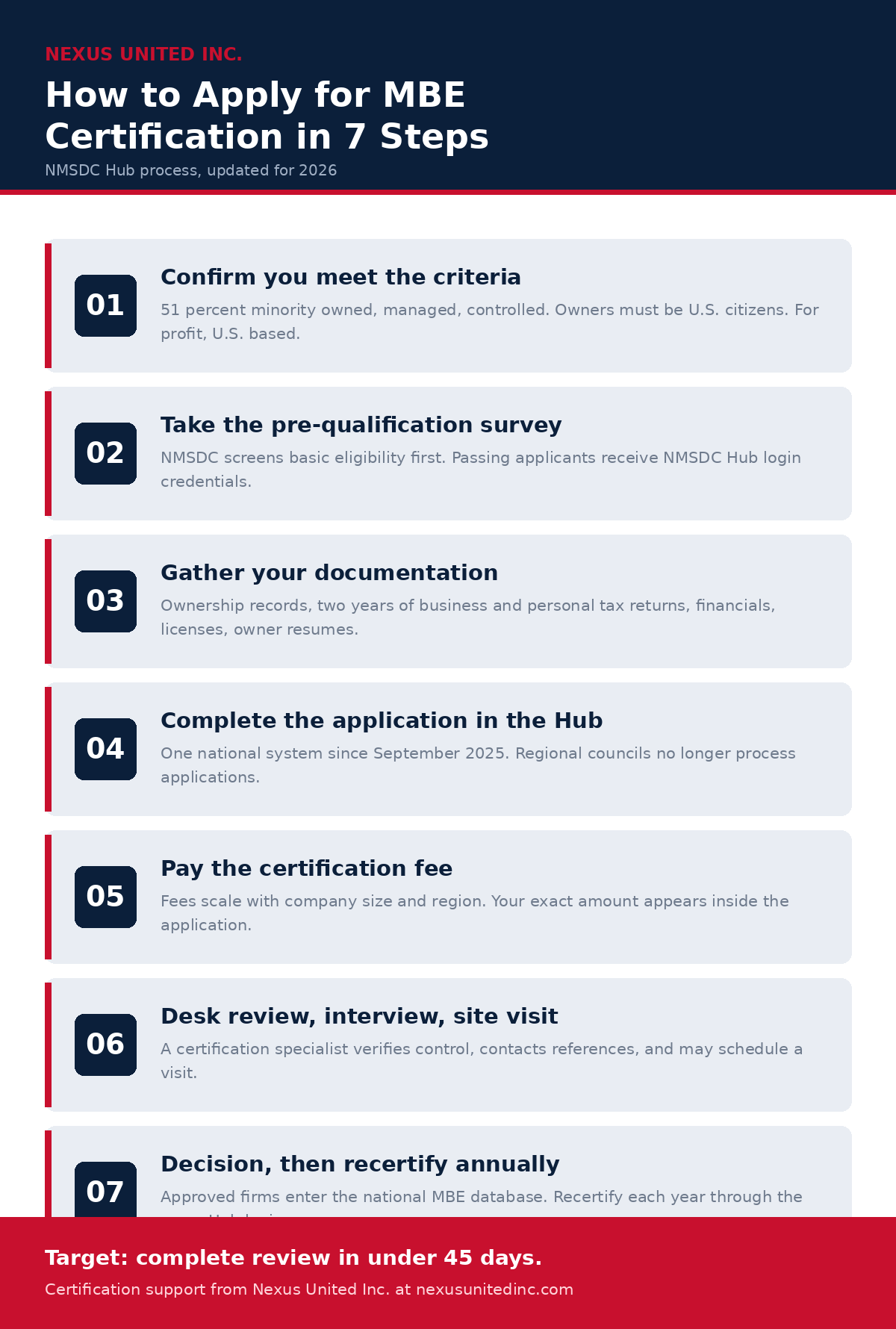
How to Apply for MBE Certification: The 7 Steps
Step 1: Confirm you meet the criteria
Review the five requirements above against your operating agreement, stock ledger, and org chart. If a non-minority partner holds veto rights over major decisions, resolve that before applying. Certification specialists look for it.
Step 2: Complete the pre-qualification survey
NMSDC screens basic eligibility before you invest time in document collection. Start at the NMSDC website and complete the short pre-qualification survey.
Applicants who pass receive login credentials for the NMSDC Hub by email. This is the single entry point for the entire process.
Step 3: Gather your documentation
Start collecting before you open the application. Incomplete submissions are the primary cause of delay.
| Category | Documents |
|---|---|
| Ownership and control | Articles of incorporation, operating agreement, bylaws, partnership agreement, stock ledger |
| Financial | Two years of business tax returns, two years of personal tax returns for each qualifying owner, current balance sheet and income statement |
| Identity and citizenship | Passport, birth certificate, or naturalization certificate for each owner counted toward the 51 percent |
| Minority status | Birth certificate or equivalent. Native American applicants provide a tribal enrollment card and blood degree certificate |
| Operations | Business licenses and permits for your industry, resumes for owners active in daily management |
| Capital | Proof of capital contributions and equipment assets, where applicable |
Two years of both business and personal returns are required. There is no exception. If your prior-year business return has not been filed, submit the extension.
Step 4: Complete the application in the NMSDC Hub
Log in and complete every field. Where a question does not apply, write “N/A” with a one-line explanation rather than leaving it blank. Blank fields generate follow-up requests, and follow-up requests reset your place in the review queue.
Upload documents as you go. The Hub tracks progress in real time.
Step 5: Pay the certification fee
Fees are based on company size and region. Published ranges run from roughly a few hundred dollars to a few thousand for large firms. Your exact fee appears inside the application once you enter your business details, so treat any figure you see elsewhere as an estimate.
Step 6: Review, interview, and site visit
A certification specialist conducts a desk review of your application and documents. They may:
- Request clarifications or missing items
- Schedule a virtual interview or an on-site visit
- Contact the references you provided
- Conduct independent research on your ownership and operations
The purpose is to confirm that the minority owner actually controls the business. Respond to requests within days, not weeks. Slow responses are the single largest driver of a long timeline.
Step 7: Decision and recertification
NMSDC targets completion of a review in under 45 days for complete applications with prompt responses. Volume and completeness both affect the actual timeline, and complex ownership structures take longer.
Approved firms are added to the national MBE database, gain a Hub profile with capability statements and video, receive the Certified by NMSDC logo, and are referred to their local affiliate for networking and development programs.
Recertification is annual. Log in to the same Hub account. If ownership, management, and control have not changed, the requirement is light: the prior year’s business federal tax return and a signed recertification affidavit. You can submit up to 90 days before your expiration date. Report any change in ownership, management, or operational control within 30 days, not at renewal.
MBE Certification Timeline
| Phase | Realistic duration |
|---|---|
| Pre-qualification survey | Same day |
| Document gathering | One to three weeks |
| Application completion | Several hours to several days |
| Desk review and clarifications | Two to four weeks |
| Interview or site visit | Scheduled within the review window |
| Decision | NMSDC targets under 45 days total |
If you are targeting a specific corporate opportunity or an NMSDC conference, start at least four months ahead. Certification is a prerequisite for participation, not a same-week credential.
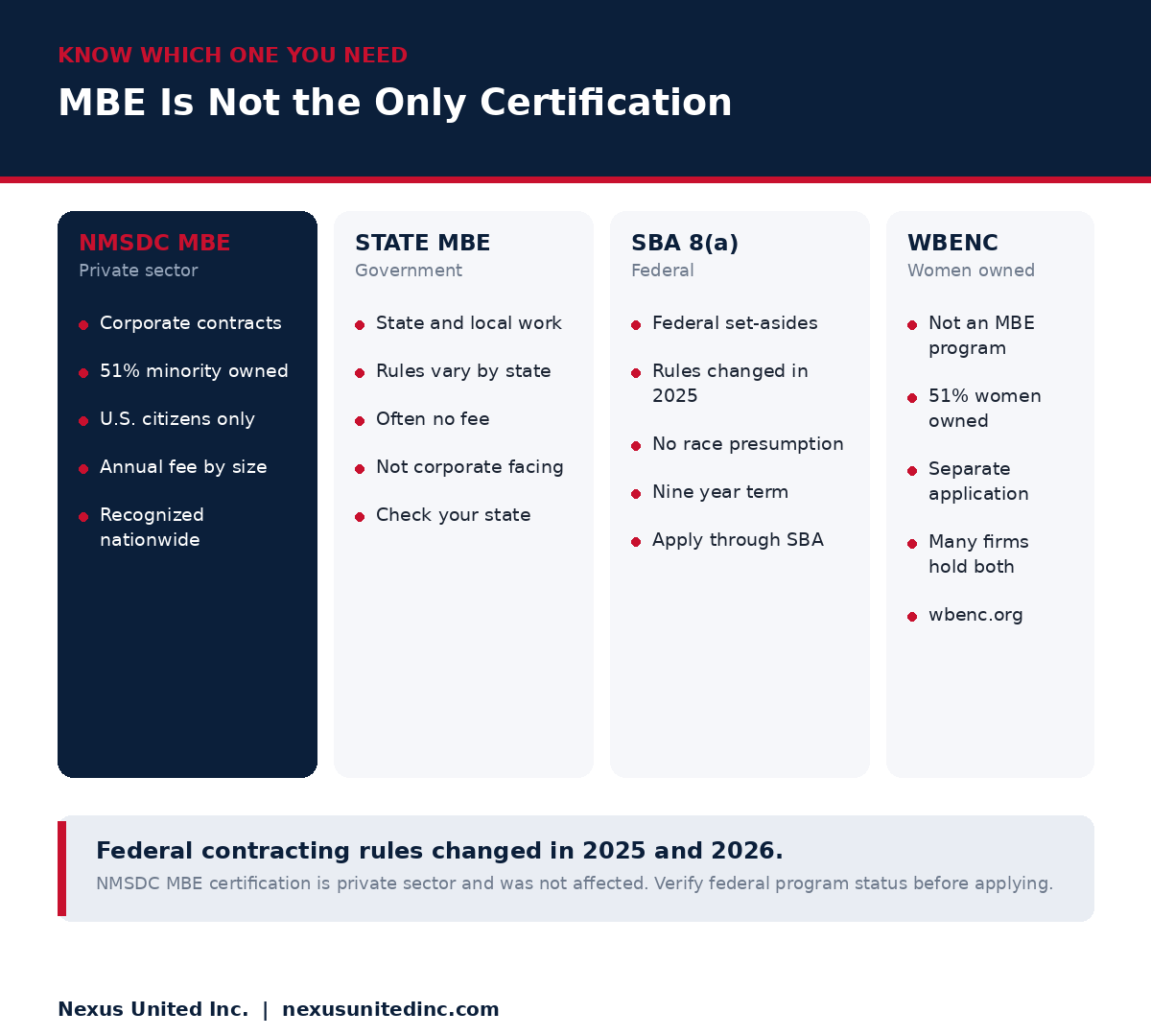
MBE, State MBE, 8(a), and WBENC: Which One Do You Need?
The original version of this guide listed WBENC as a minority certifying body. That is not correct. WBENC certifies women-owned businesses. Many firms hold both certifications, but they are separate applications with separate criteria.
| Certification | Issued by | Opens the door to | Cost |
|---|---|---|---|
| NMSDC MBE | NMSDC, private sector | Corporate supplier diversity programs | Annual fee, scaled by size |
| State or local MBE | State and municipal agencies | State and local government contracts | Often free |
| SBA 8(a) Business Development | Small Business Administration | Federal set-aside contracts | No application fee |
| WBENC WBE | WBENC, private sector | Corporate programs for women-owned firms | Annual fee |
A note on federal programs. The eligibility framework for the SBA 8(a) program and the Department of Transportation’s Disadvantaged Business Enterprise program changed substantially in 2025 and 2026. Both agencies removed race- and sex-based presumptions of disadvantage following federal court rulings, and both now require applicants to submit individualized evidence. SBA published a proposed rule in June 2026 that would further revise the 8(a) social disadvantage test. Currently certified DBE firms are subject to reevaluation.
None of this affects NMSDC MBE certification, which is a private-sector program. If federal contracting is part of your strategy, verify the current status of those programs directly with SBA or DOT before you invest in an application.
Common Reasons Applications Stall
| Problem | What to do instead |
|---|---|
| Missing personal tax returns | Submit two years for every owner counted toward the 51 percent |
| Blank application fields | Enter N/A with a short explanation |
| Non-minority partner holds veto rights | Amend the operating agreement before applying |
| A green card holder counted toward 51 percent | Recheck citizenship. Only U.S. citizens qualify |
| Franchise agreement limits the owner’s authority | Prepare additional documentation showing real operational control |
| Slow responses to specialist requests | Assign one person to monitor the Hub daily during the review |
Frequently Asked Questions
How long does MBE certification take?
NMSDC targets under 45 days for a complete application with prompt responses. Document gathering beforehand typically adds one to three weeks. Plan for two to three months end-to-end.
How much does MBE certification cost?
Fees vary by company size and region. Your exact fee is calculated inside the application after you enter your business details.
Can a startup get MBE certified?
Yes. NMSDC guidelines do not exclude emerging or startup businesses, provided the company meets all criteria and can produce the required documentation.
Can a green card holder qualify?
No. Every owner counted toward the 51 percent threshold must be a United States citizen.
Does a 50/50 partnership qualify?
No. Minority ownership must be at least 51 percent, with corresponding control.
Does MBE certification guarantee contracts?
No. NMSDC states plainly that certification is an eligibility designation. It does not award contracts, confer procurement preferences, or guarantee business outcomes. It gives you visibility to buyers who are looking.
Do I still apply through my regional council?
No. Since September 15, 2025, all applications and recertifications run through the NMSDC Hub. Regional councils still provide local programming and support to certified firms.
What if I started an application before the change?
Applicants who began before September 2025 should have received Hub login credentials by email. Contact NMSDC’s national certification team if you did not.
Support for Minority-Owned Firms
Certification is a documentation exercise before it is anything else. Ownership records that contradict each other, tax returns that were never filed, and operating agreements that quietly hand control to a minority partner’s co-signer are what turn a 45-day review into a six-month one.
Nexus United Inc. provides accounting, bookkeeping, and business advisory support to independent tax offices and small businesses, including the financial statement preparation and tax filing history that certification applications require.