An income tax preparation course is one of the few professional credentials that pays for itself in a single season. The federal government does not license tax preparers. Anyone with a Preparer Tax Identification Number and $18.75 can legally prepare returns for compensation. That low barrier is exactly why training matters: it is the only thing separating a preparer who can handle a Schedule C and a rental property from one who cannot, and clients have no way to tell the difference except by credentials.
The 2025 tax law rewrote more than sixty provisions and added a new schedule to Form 1040. Preparers who trained before that change are working from an outdated map. An income tax course closes that gap, feeds directly into the IRS Annual Filing Season Program, and satisfies the qualifying education that four states require before you can charge a fee at all. Nexus United Inc. trains and supports independent tax offices nationwide. This is what the training actually buys.
What the Credential Landscape Looks Like
Understanding where a course fits requires understanding what the IRS does and does not require.
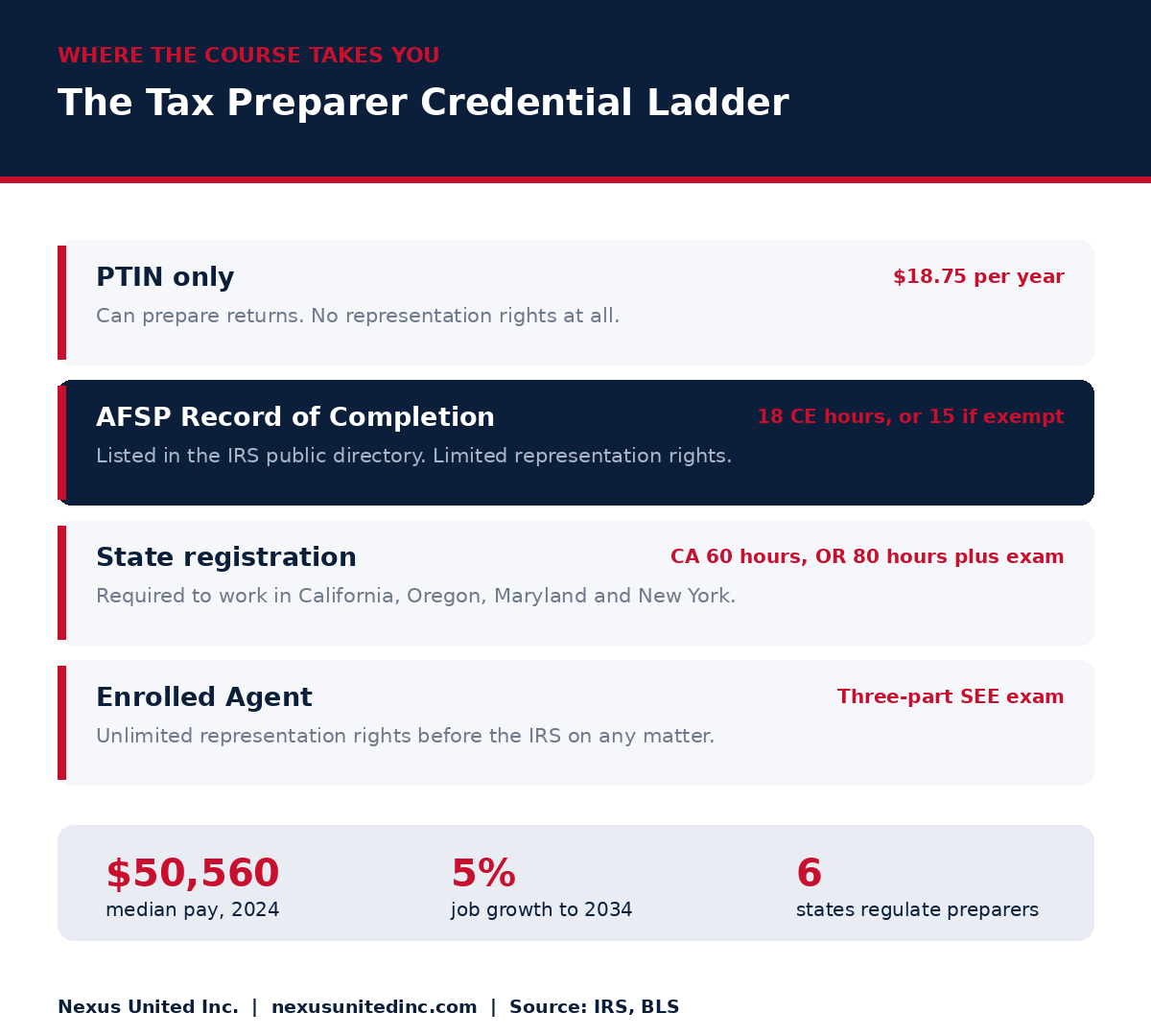
| Level | What it takes | What you can do |
|---|---|---|
| PTIN only | $18.75 annual fee, 15 minutes online | Prepare and sign federal returns. No representation rights whatsoever |
| AFSP Record of Completion | 18 hours of IRS-approved CE, including a 6-hour Annual Federal Tax Refresher course and test. 15 hours if exempt | Listed in the IRS public directory. Limited representation rights for returns you prepared and signed |
| State registration | Varies. California requires 60 hours. Oregon requires 80 hours plus an exam | Legally prepare returns in regulated states |
| Enrolled Agent | Pass the three-part Special Enrollment Examination | Unlimited representation rights before the IRS on any matter |
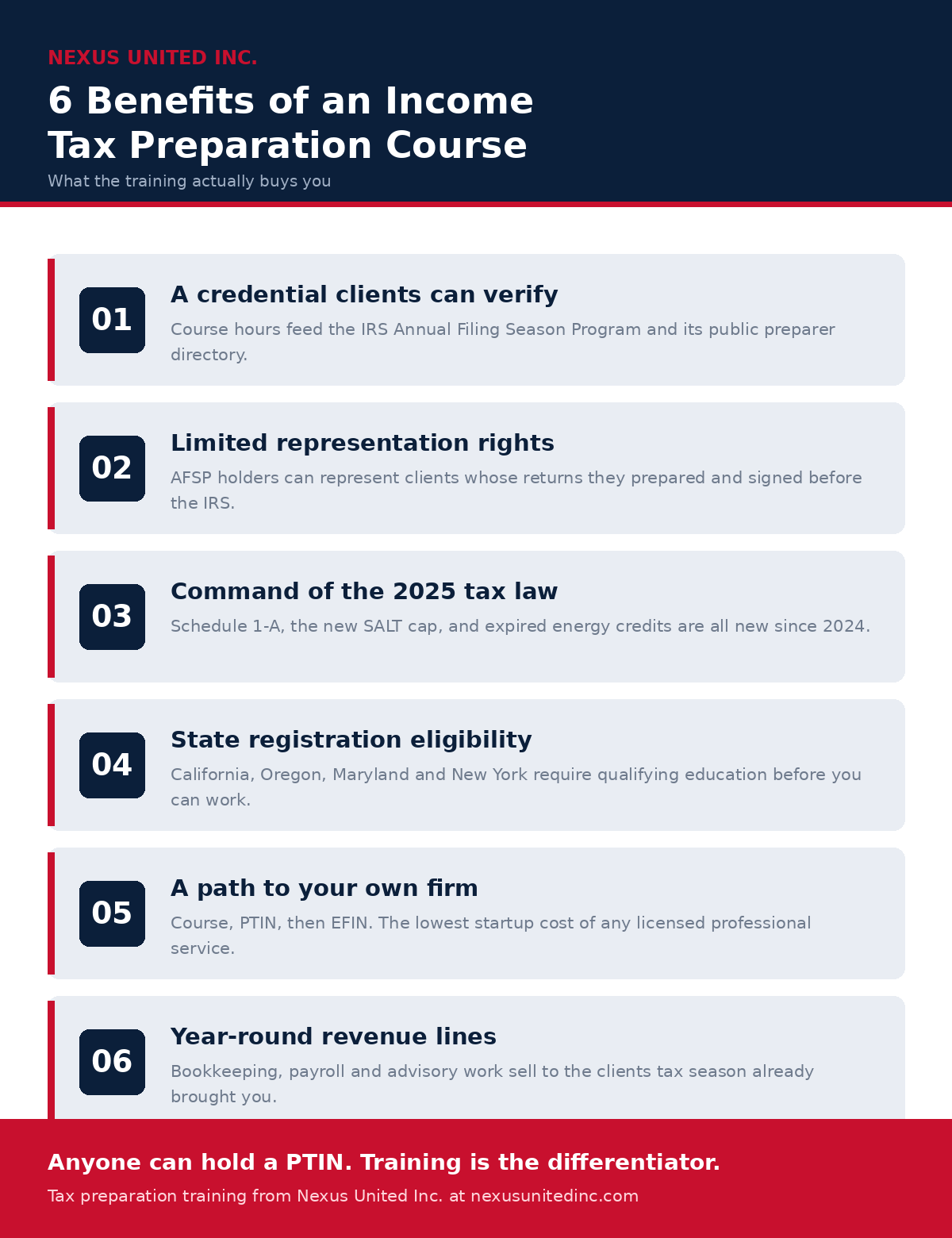
A PTIN is a number. It says nothing about competence. The AFSP Record of Completion is what puts your name in the IRS Directory of Federal Tax Return Preparers with Credentials and Select Qualifications, which is where taxpayers look when they are told to choose a preparer carefully.
1. Confidence Handling Returns That Pay
The money in tax preparation is not in the simple 1040. It is in the return with a rental property in another state, an S corporation, a home office, three W-2s, and a client who worked overtime and earned tips.
Course training teaches the mechanics: which form, which schedule, which election, and what documentation the IRS expects behind it. That knowledge changes what you can charge. The National Society of Accountants has reported average hourly billing for tax preparers well above what an untrained preparer earns per return.
It also changes what you can decline. Knowing that a W-2 employee cannot claim a home office deduction protects the client from an audit and protects you from preparer penalties.
2. Limited Representation Rights Before the IRS
This is the benefit most articles miss.
Since 2016, a preparer holding only a PTIN has no authority to represent a client before the IRS. None. If your client gets a notice, you cannot speak for them.
An AFSP Record of Completion changes that. Holders can represent clients whose returns they prepared and signed before revenue agents, customer service representatives, and the Taxpayer Advocate Service. No appeals. Not collections. But enough to handle the notices that actually arrive.
To earn it for a filing season, you must:
- Complete 18 hours of continuing education from an IRS-approved provider, including the 6-hour Annual Federal Tax Refresher course and its 100-question test, passed with a score of 70 percent or better
- Hold an active PTIN for the upcoming year
- Consent to the practice obligations in Circular 230, Subpart B, and section 10.51
Exempt preparers, including those registered in California, Oregon, or Maryland, need 15 hours instead: 10 hours of federal tax law, 3 hours of updates, and 2 hours of ethics. All hours must be completed by December 31.
3. Current Command of Tax Law That Just Changed
Tax law does not change gradually. It changes in bulk when Congress passes a bill.
The 2025 law introduced a new Schedule 1-A carrying four deductions that did not exist before: for tips, overtime premium pay, car loan interest, and taxpayers aged 65 and older. It raised the state and local tax deduction cap from $10,000 to $40,400, which pushes homeowners in high-tax states back into itemizing for the first time since 2017. It created an above-the-line charitable deduction for people who do not itemize and a new 0.5 percent floor for people who do. It terminated the residential solar and energy efficiency credits at the end of 2025.
A preparer who does not know those changes will file returns that leave money on the table or claim credits that no longer exist. Both cost clients. One of them costs you.
A current course covers this. A course from three years ago does not.
4. Eligibility to Work in Regulated States
Six states impose requirements beyond the federal PTIN. If you live in one, a course is not optional.
| State | Requirement |
|---|---|
| California | 60-hour qualifying education from a CTEC-approved provider, $5,000 surety bond, PTIN, CTEC registration. 20 hours of CE annually |
| Oregon | 80-hour basic course and a state exam. Oregon is the only state that licenses preparers |
| Maryland | Registration with the state board, passing a state exam, and continuing education |
| New York | Annual registration and CE if you file more than ten returns |
| Connecticut | Permit required if you prepare more than ten Connecticut returns. An AFSP Record of Completion is required to obtain one |
| Nevada | Registration required |
California penalizes unregistered preparers $2,500 for a first failure. That is not a rounding error on a seasonal income.
5. A Realistic Path to Owning a Firm
Tax preparation has the lowest startup cost of any licensed professional service. There is no degree requirement, no state bar, no residency.
The sequence is short:
- Complete an income tax preparation course
- Obtain a PTIN from the IRS in about 15 minutes online
- Apply for an EFIN so you can e-file under your own firm, which takes the IRS roughly 45 days
- Complete state registration if you are in a regulated state
- Earn the AFSP Record of Completion for directory listing and representation rights
Apply for the EFIN early. It is the long pole, and the IRS runs a suitability check that includes a criminal history and tax compliance review.
Course training also covers what a tax textbook does not: client intake, pricing, engagement letters, off-season cash flow, and the difference between a preparer and a business owner.
6. Services You Can Sell Year-Round
Tax season runs three and a half months. The offices that survive the other eight and a half sell something else to the clients they have already earned trust from.
| Service | Why it converts | Billing |
|---|---|---|
| Bookkeeping | You already see the books at filing time | Monthly retainer |
| Payroll | Small employers want one point of contact | Per pay run |
| Tax planning | Advisory work, not compliance work | Project or retainer |
| Business formation | New clients need an entity before they need a return | Flat fee |
| IRS notice response | AFSP holders can act on returns they prepared | Hourly |
Recurring revenue changes what your practice is worth. A firm collecting twelve months of fees sells for a multiple that a three-month firm does not command.
What the Numbers Say
The Bureau of Labor Statistics reports a median annual wage of $50,560 for tax preparers as of May 2024, with the top decile above $98,000. Employment is projected to grow 5 percent from 2024 to 2034, faster than the average across all occupations.
Two caveats worth stating honestly. Tax preparation income is seasonal and variable, and entry-level data-entry work is exposed to automation. The work that is not exposed is advisory, complex returns, and representation. That is precisely the work training prepares you for.
Choosing a Course
Not all courses are equal. Check for:
- IRS-approved CE provider status. Hours from a non-approved provider do not count toward the AFSP. Providers report your credits directly to your PTIN account.
- State approval where relevant. A CTEC-approved 60-hour course is not interchangeable with a generic 45-hour federal course.
- Current-year content. Ask specifically whether the curriculum covers Schedule 1-A and the 2025 law changes.
- Business training, not just tax law. If you intend to open an office, tax knowledge is half the requirement.
- Software instruction. Knowing the code is different from knowing the platform you will file on.
Frequently Asked Questions
Do I need a license to prepare taxes?
Not at the federal level. You need a PTIN. Six states add their own registration, education, or licensing requirements. Oregon is the only state that issues a license.
How much does a PTIN cost?
$18.75 for 2026. It expires on December 31 each year and must be renewed.
Is the Annual Filing Season Program required?
No. It is voluntary. What it provides is a listing in the IRS public directory and limited representation rights, neither of which a PTIN-only preparer has.
How long does an income tax course take?
A 60-hour qualifying education course can be finished in roughly two weeks of focused study. AFSP continuing education is 18 hours per year, or 15 if you are exempt.
Can I take an income tax course with no accounting background?
Yes. Most entry courses assume none. Comfort with arithmetic and attention to detail matter more than prior accounting coursework.
What is the difference between an AFSP and an Enrolled Agent?
AFSP is a filing season qualification requiring annual continuing education. Enrolled Agent is an IRS credential earned by passing a three-part exam, and it carries unlimited representation rights.
Do I need an EFIN?
You need one to e-file returns under your own firm. The IRS requires e-filing once you file more than ten returns. Apply at least 45 days before you intend to file.
Train With Nexus United Inc.
An income tax preparation course is the entry fee. What determines whether the practice survives is what comes after: professional software, a bank product relationship so your clients can get refund advances, someone to call when a client walks in with a partnership dissolution, and a business plan for the eight months when nobody is filing.
Nexus United Inc. provides income tax preparation training alongside software access, legal and CPA support, and business development programs for independent preparers. The training and the infrastructure arrive together.