
Learning how to get a bigger tax refund comes down to two things: paying in the right amount during the year and claiming every deduction and credit you legally qualify for before you file. Most taxpayers overpay on one and underclaim on the other. The 2025 tax law rewrote large parts of the code, so the moves that produced a bigger tax refund three years ago are not the same moves that work for your 2026 return. Some credits disappeared. Several new deductions replaced them.
Nexus United Inc. prepares returns across the country every filing season. The patterns repeat. People miss the Saver’s Credit. They itemize when the standard deduction is higher. They forget the retirement contribution they can still make after December 31. This guide covers the current rules for tax year 2026, which you file in early 2027, and shows where the money usually hides.

First, Understand What a Refund Actually Is
A refund is not a bonus. It is the return of money you already gave the government. The IRS holds it interest-free until you file.
Your refund equals what you paid in, minus what you owe. That gives you two levers:
- Lower what you owe through deductions, credits, and pre-tax contributions.
- Adjust what you pay in through your Form W-4 or estimated payments.
A large refund with a large paycheck shortfall all year is not a win. A refund produced by credits you had not claimed before is.
1. Check Your Withholding Now, Not in April
The IRS did not fully adjust withholding tables when the new deductions took effect. Some workers had too little withheld, which shrinks the refund or creates a balance due.
Review your Form W-4 with your employer at least once mid-year and again after any of these:
- Marriage, divorce, or the birth of a child
- A second job or a working spouse
- Starting freelance or gig income
- A large bonus or equity vesting
- Retirement or a change in Social Security benefits
Self-employed filers should recheck quarterly estimated payments instead. Underpayment penalties reduce your refund even when your deductions are perfect.
2. Run the Standard Deduction Against Itemizing Every Year
For tax year 2026, the standard deduction is:
| Filing status | 2026 standard deduction |
|---|---|
| Single | $16,100 |
| Married filing jointly | $32,200 |
| Head of household | $24,150 |
| Married filing separately | $16,100 |
Itemizing only helps if your total deductions on Schedule A exceed those figures. The state and local tax cap moved from $10,000 to $40,400 for 2026, which pushes many homeowners in high-tax states back into itemizing for the first time since 2017.
Common itemized deductions worth adding up:
- State and local income or sales tax, plus property tax, capped at $40,400
- Mortgage interest, and private mortgage insurance, which is deductible again
- Charitable contributions above 0.5 percent of your adjusted gross income
- Out-of-pocket medical expenses above 7.5 percent of adjusted gross income
- Casualty losses in federally declared or certain state-declared disaster areas
One caution. Unreimbursed employee business expenses are no longer deductible. That deduction was eliminated in 2018 and the elimination is now permanent. If a preparer suggests writing off your mileage or supplies as a W-2 employee, get a second opinion.
3. Claim the New Schedule 1-A Deductions
Four deductions created by the 2025 law run from tax year 2025 through 2028. All four sit on the new Schedule 1-A, and all four are available whether you itemize or take the standard deduction.
| Deduction | Maximum | Phase-out begins (MAGI) |
|---|---|---|
| Qualified tips | $25,000 | $150,000 single, $300,000 joint |
| Qualified overtime premium pay | $12,500 per taxpayer | $150,000 single, $300,000 joint |
| Car loan interest, personal use vehicle | $10,000 | $100,000 single, $200,000 joint |
| Senior deduction, age 65 and older | $6,000 per person | $75,000 single, $150,000 joint |
Details that cost people money:
- The tips deduction covers occupations the IRS lists as customarily tipped before 2025.
- Overtime counts only the premium portion, meaning the extra half of time and a half.
- Car loan interest requires the vehicle identification number on the return, and the vehicle must be purchased after 2024. Leases do not qualify.
- The senior deduction stacks on top of the existing additional standard deduction for age 65 and older.
4. Fund Retirement Accounts Before the Deadline
Pre-tax retirement contributions reduce taxable income dollar for dollar. Contributions to a traditional IRA can still be made until the April filing deadline, which means you can raise your refund after the tax year has closed.
| Account | 2026 limit | Catch-up |
|---|---|---|
| 401(k), 403(b), most 457(b) | $24,500 | $8,000 at age 50, $11,250 at ages 60 to 63 |
| Traditional or Roth IRA | $7,500 | $1,100 at age 50 |
| SIMPLE IRA | $17,000 | $4,000 at age 50 |
| HSA, self-only coverage | $4,400 | $1,000 at age 55 |
| HSA, family coverage | $8,750 | $1,000 at age 55 |
A rule change matters this year. If your wages from your plan sponsor exceeded $150,000 in the prior year, your age 50 catch-up contribution must go into a Roth account. That contribution no longer reduces current-year taxable income.
5. Take the Saver’s Credit if You Qualify
The Retirement Savings Contributions Credit is the most overlooked line on the return. It pays you a money credit you were already going to save.
The credit is worth up to $1,000, or $2,000 on a joint return. Income limits for 2026:
- Married filing jointly: $80,500
- Head of household: $60,375
- Single or married filing separately: $40,250
You claim the deduction for the contribution and the credit for making it. Both in the same year.
6. Collect Every Child and Dependent Benefit
Families leave more refund money on the table than any other group.
Child Tax Credit.
Worth up to $2,200 per qualifying child under 17. Up to $1,700 per child is refundable through the Additional Child Tax Credit, which means it can pay you even when your tax liability reaches zero. The child and the taxpayer both need a valid Social Security number. Figure the amount on Schedule 8812.
Child and Dependent Care Credit.
The top credit rate rose from 35 percent to 50 percent starting in tax year 2026. Applied to the expense caps of $3,000 for one dependent and $6,000 for two or more, the maximum credit is now $1,500 and $3,000. The rate steps down as income rises but never falls below 20 percent.
Dependent care FSA.
The annual limit rose from $5,000 to $7,500. Money you run through the FSA reduces credit-eligible expenses dollar for dollar, so the two do not stack. For most households under roughly $150,000, the credit now beats the FSA. Above that, the FSA usually wins. Run both numbers.
Earned Income Tax Credit.
Fully refundable, worth up to $8,231 in 2026 for filers with three or more qualifying children. Note that the IRS holds refunds containing the EITC or the Additional Child Tax Credit until mid-February under the PATH Act, regardless of when you file.
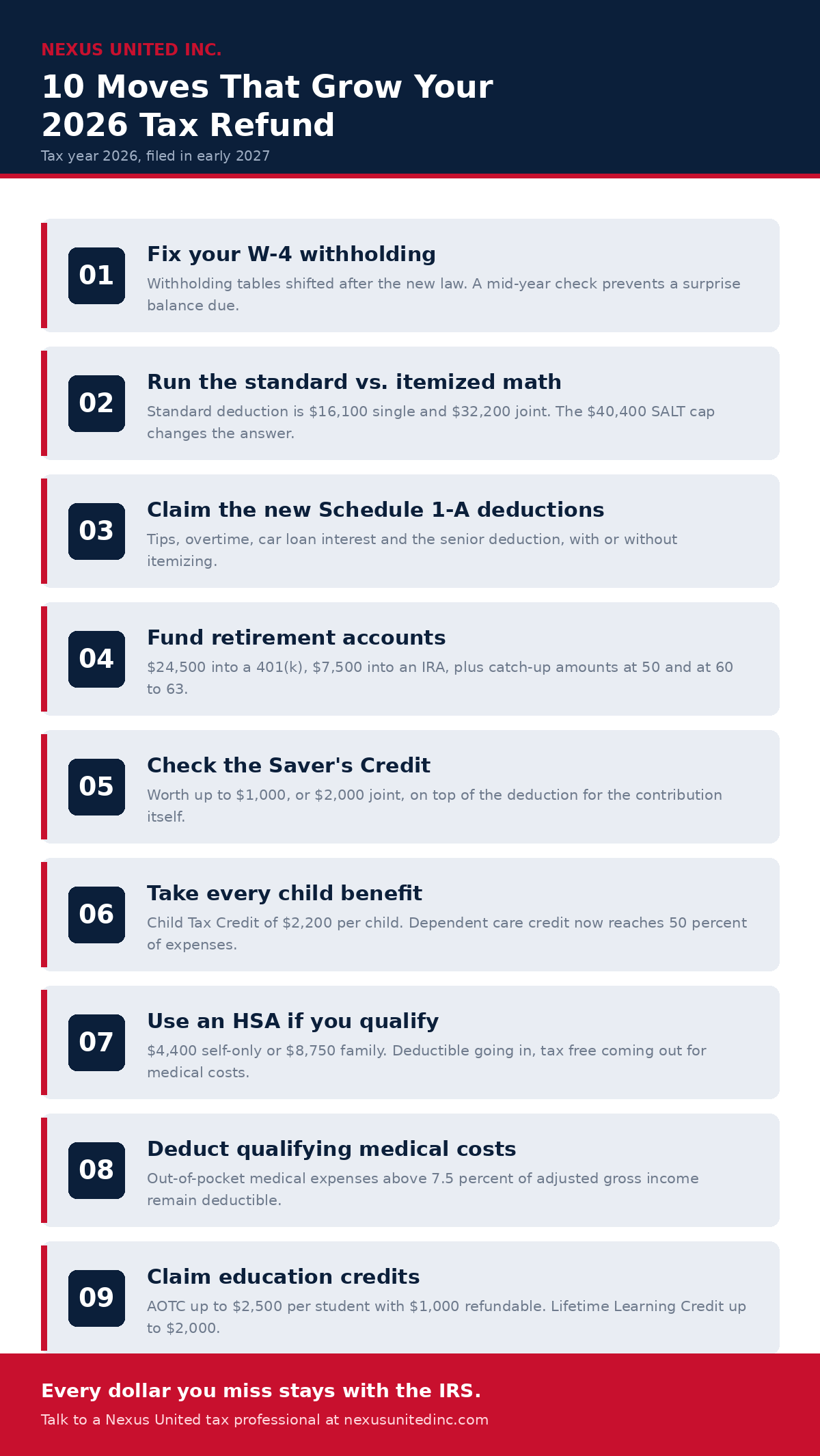
7. Use Health Accounts to Lower Taxable Income
A health savings account is the only vehicle in the code with three tax advantages: contributions reduce taxable income, growth is untaxed, and qualified withdrawals are untaxed. You need coverage under a qualifying high-deductible health plan.
Medical expenses that exceed 7.5 percent of adjusted gross income remain deductible on Schedule A. Costs that count include prescriptions, surgeries, dental work, vision care, mileage to appointments, and prescribed medical equipment. Cosmetic procedures and general wellness spending do not.
Self-employed filers can deduct health insurance premiums above the line, without itemizing.
8. Claim Education Credits Correctly
| Credit | Maximum | Refundable? | Availability |
|---|---|---|---|
| American Opportunity Tax Credit | $2,500 per student | 40 percent, up to $1,000 | First four years of undergraduate study |
| Lifetime Learning Credit | $2,000 per return | No | Any year, including graduate and continuing education |
The AOTC is the stronger credit because part of it comes back as cash. The Lifetime Learning Credit phases out between $80,000 and $90,000 of modified adjusted gross income, or $160,000 and $180,000 on a joint return. You cannot claim both credits for the same student in the same year.
9. Document Charitable Giving Under the New Rules
Two changes took effect in 2026.
Non-itemizers can now deduct up to $1,000 in cash contributions, or $2,000 on a joint return, directly on Schedule 1. Donations to donor-advised funds and private non-operating foundations do not qualify.
Itemizers face a new floor. Only charitable contributions above 0.5 percent of adjusted gross income are deductible. On $120,000 of AGI, the first $600 of giving produces no deduction.
Keep the written acknowledgment for every gift of $250 or more. Non-cash donations above $500 require Form 8283.
10. Know Which Credits Ended
The original advice to install solar panels for a tax credit no longer applies. Both residential energy credits terminated on December 31, 2025.
| Credit | Status |
|---|---|
| Residential Clean Energy Credit, Section 25D | Ended for expenditures made after December 31, 2025 |
| Energy Efficient Home Improvement Credit, Section 25C | Ended for property placed in service after December 31, 2025 |
| Clean Vehicle Credit, Section 30D | Ended September 30, 2025 |
| Previously Owned Clean Vehicle Credit, Section 25E | Ended September 30, 2025 |
| Alternative Fuel Vehicle Refueling Property Credit, Section 30C | Ends for property placed in service after June 30, 2026 |
Unused credit amounts from qualifying installations completed before the deadline can still be carried forward. State-level rebates and utility programs continue in many states, though they operate outside the federal return.
11. Homeowners and the Home Office
Mortgage interest and property tax remain deductible for itemizers, and the higher SALT cap makes that combination worth checking again.
The home office deduction is available to self-employed filers and business owners only. Employees who work from home cannot claim it, even if the employer requires remote work and provides no reimbursement. This is the single most common error in DIY returns.
12. Work With a Tax Professional
The 2025 law changed more than sixty provisions and added a new schedule to Form 1040. Software prompts you with questions. It does not tell you what you failed to mention.
A preparer who works returns year-round will catch the retirement contribution you can still make, the credit you assumed you earned too much to claim, and the deduction you took that you were not entitled to. The second one protects your refund. The third one protects you from an audit.
Frequently Asked Questions
How can I get a bigger tax refund this year?
Contribute to a traditional IRA or HSA before the filing deadline, claim every credit you qualify for, including the Saver’s Credit and the Child and Dependent Care Credit, compare itemizing against the standard deduction, and review the four new deductions on Schedule 1-A for tips, overtime, car loan interest, and age 65 and older.
Is a bigger refund always a good thing?
Not necessarily. A refund driven by over-withholding means you loaned the government money at zero interest. A refund driven by credits and deductions you were entitled to is real money you would otherwise have lost.
Can I still claim the solar tax credit?
No. The Residential Clean Energy Credit ended for expenditures made after December 31, 2025. Installations completed before that date can still carry forward any unused credit.
Do the tips and overtime deductions require itemizing?
No. All four Schedule 1-A deductions are available to filers who take the standard deduction.
When will I get my refund?
Electronically filed returns with direct deposit typically fund within 21 days. Returns claiming the Earned Income Tax Credit or the Additional Child Tax Credit are held until mid-February by law.
Should I itemize in 2026?
Add up your state and local taxes up to $40,400, mortgage interest, charitable gifts above 0.5 percent of AGI, and medical costs above 7.5 percent of AGI. If the total beats $16,100 single or $32,200 joint, itemize.
Get Your Refund Reviewed by a Professional
Understanding how to get a bigger tax refund starts with knowing which rules changed and which ended. The tax professionals at Nexus United Inc. and Tax USA Now review your withholding, your deductions, and every credit you qualify for, then file a return that holds up.
Visit Nexus United Inc or call (855) 639- 8740 to have your return reviewed before you file.